HealthClinics Sports Kids CarrierClinics Kit Activation Clinics
See all topics
Sequencing 6 Min read

Whole exome vs. whole genome sequencing

Reading the key chapters versus reading the entire book. Understanding when a narrower view is sufficient — and when you need the full picture.

The Library Analogy

Imagine your genome as a library of 3,000 books. The vast majority of those books are reference material, indexes, and notes. Only about 1-2% of the shelves contain the active recipes — the genes that get translated into proteins. This protein-coding part of the genome is called the exome.

Whole exome sequencing (WES) reads only those active recipe books. Whole genome sequencing (WGS) reads the entire library — recipes, indexes, and everything in between.

Why WES Was Popular First

For years, WES was the practical choice. It was much cheaper, faster, and easier to interpret. Most known disease-causing variants live in the exome, so for diagnosing genetic conditions WES often gave a strong answer for a fraction of the cost.

If you only care about the parts of the genome we already understand well, WES is a reasonable option.

What WES Misses

The 98-99% of the genome outside the exome isn't empty — it controls *when, where, and how much* of each protein gets made. Mutations in these regulatory regions can cause real disease, and WES sees none of them.

WES also misses structural changes, repeat expansions, and complex rearrangements that span large regions of the genome. As genetics research has matured, more and more important findings have come from outside the exome.

Why WGS Is Becoming the Standard

Two things changed. First, sequencing costs dropped dramatically — WGS today costs roughly what WES did a few years ago. Second, we now understand far more about non-coding DNA, so the extra data is no longer wasted.

WGS gives you:

- Complete coverage of every gene (more reliable than WES even within the exome)

- Visibility into regulatory regions

- Better detection of structural variants

- A future-proof dataset — as science improves, your genome can be re-analyzed without needing a new sample

Which Does bioRitma Use?

bioRitma uses whole genome sequencing. We believe it's the right long-term choice: you sequence once, and as new research connects more variants to traits and conditions, your insights keep getting richer without another sample.

Next

What is a polygenic risk score?

FAQ

Find the answers to your questions.


Your results offer a comprehensive view of how your genetics influence mental and cognitive traits, physical characteristics, potential health risk factors, and how your body responds to different nutrients and dietary patterns. By combining insights across these areas, you gain a clearer understanding of your overall well-being and how your DNA interacts with your lifestyle.


Our analysis is built on high-quality genetic sequencing and established scientific research to provide reliable and meaningful insights. While genetic testing offers a powerful way to understand patterns and predispositions, results are probabilistic rather than absolute. This means your insights reflect tendencies and risk levels — not guaranteed outcomes or medical diagnoses.
We continuously update our analyses as scientific knowledge evolves, ensuring your results remain aligned with the latest research.


After completing your order, your DNA kit is delivered within a few business days. Once your sample is collected and sent back to the lab, our process only takes up to 10 days. You'll be notified by email as soon as your results are ready to view. You can view all your detailed results from your bioRitma app.


Your privacy is a core priority. Your genetic and personal data are stored securely within our own protected systems and are never shared with third parties without your explicit consent. You remain in full control of your data and can request its removal from our database at any time.
We follow strict security and privacy practices — fully aligned with KVKK (Turkey's Personal Data Protection Law No. 6698) and GDPR-grade protections, where genetic data is treated as a special category — to ensure your information is handled confidentially and responsibly throughout the entire process.

Where your genetic insights come together.

View your results, track changes in the scientific literature related to you, and receive personalized information — all in one secure mobile app.
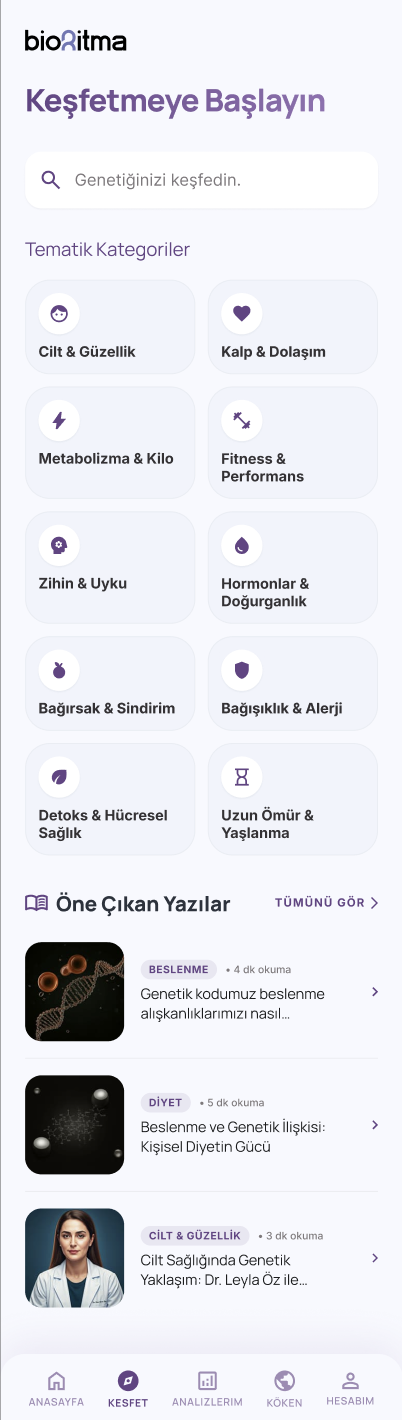

App Screen App Screen App Screen App Screen App Screen App Screen App Screen

Purchase your DNA kit

KVKK Certificate 2