Your risk for common conditions isn't determined by a single gene — it's the sum of hundreds of tiny signals scattered across your genome. Here's how those signals are combined into a single score.
Some conditions are caused by a single gene. Cystic fibrosis, sickle cell disease, and Huntington's disease all trace back to mutations in one specific gene. If you carry the mutation, you're at very high risk; if you don't, you're not.
But most common conditions don't work that way. Heart disease, type 2 diabetes, depression, obesity, Alzheimer's — these are influenced by hundreds or even thousands of variants scattered across your genome, each contributing a tiny push.
A polygenic risk score (PRS) is a way to summarize all those tiny pushes into a single number. Researchers identify variants associated with a condition through large studies (often involving hundreds of thousands of participants), measure how much each one raises or lowers risk, and create a formula that adds them all up.
When you get sequenced, your PRS is calculated by checking which of those variants you carry and applying the weights. The result is your individual genetic risk relative to the general population.
A polygenic score isn't a probability — it's a position. Saying you're in the 90th percentile for type 2 diabetes risk doesn't mean you have a 90% chance of getting it. It means your genetic risk is higher than 90% of the population studied.
Whether that translates to a real risk of disease depends on absolute baseline rates, your age, your lifestyle, and other factors. A high PRS for a rare condition still means low absolute risk; a moderate PRS for a common condition can still mean significant absolute risk.
PRS works best for conditions where:
- Lots of common variants contribute (true for most chronic diseases)
- Large studies have been done across many populations
- Lifestyle interventions exist that meaningfully change outcomes
For these conditions, knowing your PRS can help you and your doctor decide what to monitor more closely and what changes to prioritize.
A polygenic score is not a diagnosis. It's not a guarantee. It's a probability shift — a way of saying "all else equal, your starting position is here." What you do from that starting position matters at least as much as the position itself.
Next
How reliable are polygenic scores?
Find the answers to your questions.
Your results offer a comprehensive view of how your genetics influence mental and cognitive traits, physical characteristics, potential health risk factors, and how your body responds to different nutrients and dietary patterns. By combining insights across these areas, you gain a clearer understanding of your overall well-being and how your DNA interacts with your lifestyle.
Our analysis is built on high-quality genetic sequencing and established scientific research to provide reliable and meaningful insights. While genetic testing offers a powerful way to understand patterns and predispositions, results are probabilistic rather than absolute. This means your insights reflect tendencies and risk levels — not guaranteed outcomes or medical diagnoses.
We continuously update our analyses as scientific knowledge evolves, ensuring your results remain aligned with the latest research.
After completing your order, your DNA kit is delivered within a few business days. Once your sample is collected and sent back to the lab, our process only takes up to 10 days. You'll be notified by email as soon as your results are ready to view. You can view all your detailed results from your bioRitma app.
Your privacy is a core priority. Your genetic and personal data are stored securely within our own protected systems and are never shared with third parties without your explicit consent. You remain in full control of your data and can request its removal from our database at any time.
We follow strict security and privacy practices — fully aligned with KVKK (Turkey's Personal Data Protection Law No. 6698) and GDPR-grade protections, where genetic data is treated as a special category — to ensure your information is handled confidentially and responsibly throughout the entire process.
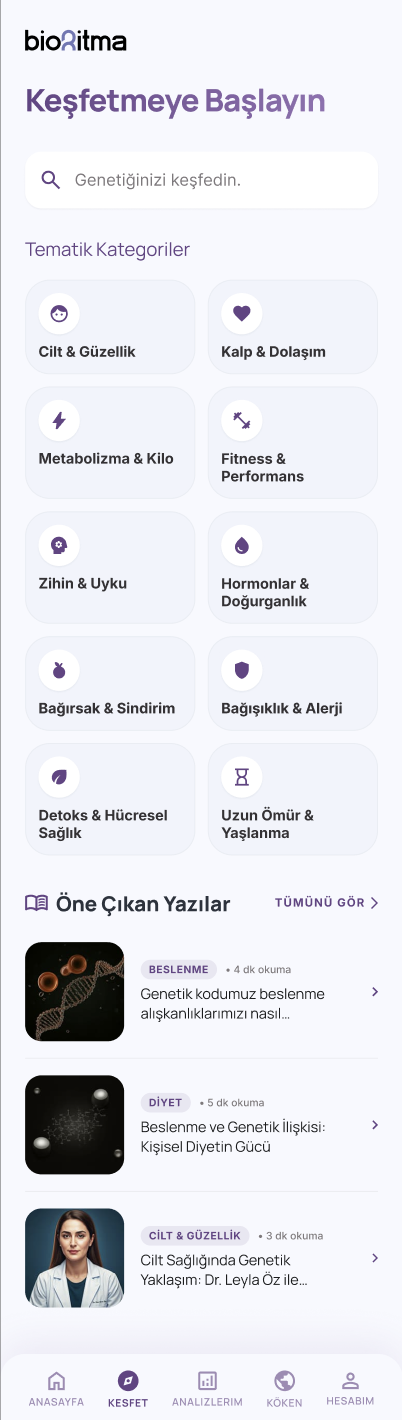
View your results, track changes in the scientific literature related to you, and receive personalized information — all in one secure mobile app.
Purchase your DNA kit