From a saliva sample to a digital map of 6 billion letters — the step-by-step process that turns biological material into readable genetic data.
Sequencing starts with cells. For consumer kits, the easiest source is saliva — when you spit into the tube, you're donating thousands of cells from the lining of your mouth, each containing a complete copy of your genome.
Your sample is stabilized with a preservative liquid that protects the DNA from breaking down during shipping. Once it arrives at the lab, the real work begins.
In the lab, technicians break open the cells using a combination of detergents, salts, and enzymes. This releases the DNA, which is then purified — separated from proteins, RNA, and cellular debris — until what remains is a clear solution of nearly pure DNA.
A typical saliva sample yields several micrograms of DNA, which is more than enough for sequencing.
A whole genome is too long to read in one go. So the DNA is chopped into millions of short fragments, typically a few hundred letters each. Special chemical "tags" are added to the ends of each fragment so the sequencing machine can recognize where to start and stop.
This collection of tagged fragments is called a sequencing library. It's essentially your genome, shredded into manageable pieces.
The library is loaded onto a sequencer — a machine that reads each fragment one letter at a time. Modern sequencers do this in massively parallel fashion, reading billions of fragments simultaneously.
Each fragment is read multiple times for accuracy. The depth of coverage matters: reading every position in your genome 30 times (called 30× coverage) gives much higher confidence than reading it once.
After sequencing, the lab has billions of short DNA reads but no map of where each one came from. Specialized software aligns each fragment against a reference human genome, like assembling a giant jigsaw puzzle where each piece overlaps with neighbors.
Once aligned, the software identifies variants — places where your DNA differs from the reference. These variants are then annotated, filtered, and interpreted. The final report you receive is the result of weeks of computational analysis.
The whole process — from the moment you seal the tube to the moment your insights appear in the app — typically takes 4 to 6 weeks. Most of that time is computation, not chemistry. The sequencing itself takes only a couple of days.
Next
Whole exome vs. whole genome sequencing
Find the answers to your questions.
Your results offer a comprehensive view of how your genetics influence mental and cognitive traits, physical characteristics, potential health risk factors, and how your body responds to different nutrients and dietary patterns. By combining insights across these areas, you gain a clearer understanding of your overall well-being and how your DNA interacts with your lifestyle.
Our analysis is built on high-quality genetic sequencing and established scientific research to provide reliable and meaningful insights. While genetic testing offers a powerful way to understand patterns and predispositions, results are probabilistic rather than absolute. This means your insights reflect tendencies and risk levels — not guaranteed outcomes or medical diagnoses.
We continuously update our analyses as scientific knowledge evolves, ensuring your results remain aligned with the latest research.
After completing your order, your DNA kit is delivered within a few business days. Once your sample is collected and sent back to the lab, our process only takes up to 10 days. You'll be notified by email as soon as your results are ready to view. You can view all your detailed results from your bioRitma app.
Your privacy is a core priority. Your genetic and personal data are stored securely within our own protected systems and are never shared with third parties without your explicit consent. You remain in full control of your data and can request its removal from our database at any time.
We follow strict security and privacy practices — fully aligned with KVKK (Turkey's Personal Data Protection Law No. 6698) and GDPR-grade protections, where genetic data is treated as a special category — to ensure your information is handled confidentially and responsibly throughout the entire process.
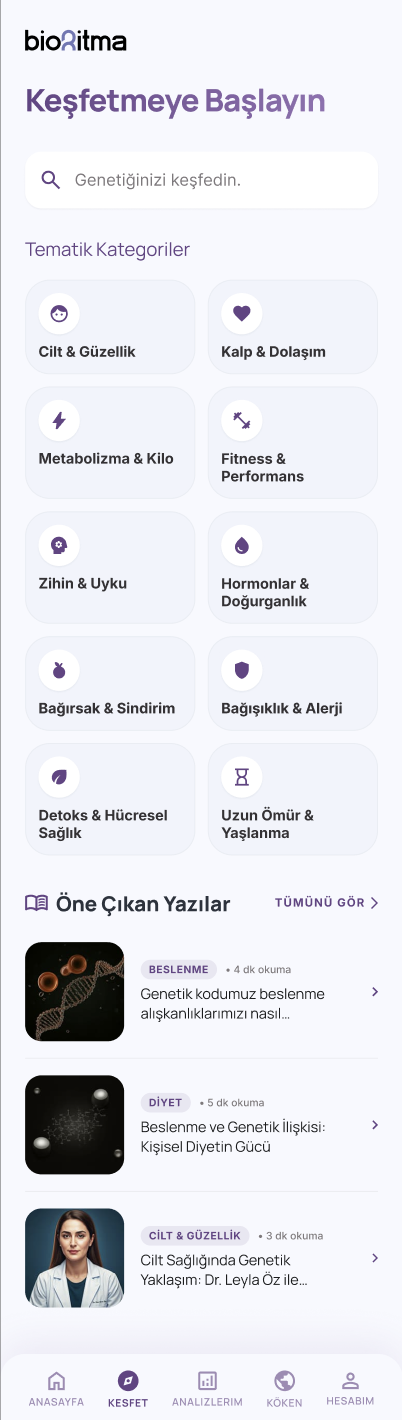
View your results, track changes in the scientific literature related to you, and receive personalized information — all in one secure mobile app.
Purchase your DNA kit